

-
The Prayer of a Righteous (Wo)Man Is Powerful and Effective
 Written by Corinne Faneus, Ministry Coordinator at Iron Rose Sister Ministries
“Well, there is nothing left to do except pray.”
“Sorry, I can’t do anything else, but I’ll pray for you.”
“The least I can do is pray.”And the prayer offered in faith will make the sick person well; the Lord will raise them up. If they have sinned, they will be forgiven. Therefore confess your sins to each other and pray for each other so that you may be healed. The prayer of a righteous person is powerful and effective. (Jas 5:15-16 NIV)
We read throughout the Scriptures multiple prayers that had incredible and powerful results—Hannah in 1 Samuel 2, Hezekiah in 2 Kings 19, and Elijah in 1 Kings 17 and 18. Prayer is shown countless times as the means by which we put our faith and trust in God as the means for God to fulfill His promises and plans in our lives. Yet, often unintentionally, with our own words, we take away the very power that prayer holds. Like the phrases above, we often minimize prayer as a last resort or as a small, almost insufficient service to those around us.
Prayer is one of the greatest gifts we have been given. That God allows and plans for our prayers to be how He is moved to action is amazing, confusing, wonderful, mysterious, and awe-inspiring. God’s hand is moved by the prayers of His creation.
If we know all this to be true about prayer, how can we be women who offer powerful and effective prayers? How can our prayers bear fruit?
It may sound cliché, but for our prayers to be powerful and effective, we must have faith in God— faith that our prayers serve a purpose, and faith that God is working through our prayers. We can often wonder, “What difference will our prayers make? If God is sovereign and has everything all planned out, what difference does it make to pray for a dear friend to be healed from sickness? Does it really matter if I pray for my unbelieving relative, if God’s will is going to be accomplished regardless?”
“Jesus replied, ‘Truly I tell you, if you have faith and do not doubt, not only can you do what was done to the fig tree, but also you can say to this mountain, ‘Go, throw yourself into the sea,’ and it will be done.’” (Mt 21:21)
Our prayers of faith make all the difference, not because we can change God’s plans, but because part of God’s plan is that we pray! We pray to bring about what God has planned. Do you trust and believe that your prayer is part of God’s sovereign plan? Do you believe that God has planned to act because of your prayer?
In James 5:17, we see James give an example of a righteous person’s powerful and effective prayer, “Elijah was a man with a nature like ours, and he prayed fervently that it might not rain, and for three years and six months it did not rain on the earth” (ESV). Being a spiritual superstar like Elijah is not what makes our prayers effective and powerful. James points out to us that Elijah was a man with a nature like ours; he was a normal human being who prayed. He was just a man who prayed fervently, and his prayers were answered. Normal average women like you and me have that same ability as Elijah because prayer is about God and not about us. Just like Elijah, we can be righteous by offering fervent, faith-filled prayers.
Ordinary women submitted to God can offer effective and powerful prayers because we pray to an extraordinary God.
-
The Resurrection of Jairo’s daughter
 Written by Débora Amaro, volunteer with Ministério Irmã Rosa de Ferro in Campo Grande, Brazil
There are several accounts about Jesus where His divinity is expressed with great power, and I believe that resurrecting people is one of the biggest demonstrations of that. We have some biblical accounts, like the widow’s son in Nain (Luke 7:11-17), Lazarus (John 11), and Jairo’s daughter (Matt. 9).
But, for the moment we will focus on Jairo’s daughter. We don’t know her name, her age, or even what she looked like. The only information we have about her is her ancestry: she’s Jairo’s daughter. Let’s take a look at the whole history:
‘‘While he was still saying this, a synagogue leader came and knelt before him and said, “My daughter has just died. But come and put your hand on her, and she will live.”
Jesus got up and went with him, and so did his disciples [...]
When Jesus entered the synagogue leader’s house and saw the noisy crowd and people playing pipes, he said, “Go away. The girl is not dead but asleep.” But they laughed at him. After the crowd had been put outside, he went in and took the girl by the hand, and she got up. News of this spread through all that region. (Matt. 9:18-19, 23-26)This complex history demonstrates Jesus’ compassion for women and children, whom, most of the time, were undervalued during the first century’s Jewish society.
We know that Jesus has power to resurrect the dead. He was resurrected himself after the crucifixion and lives today at the Father’s right hand. But, one thing is knowing, reading and listening about it. It’s another thing to actually experience it.
And that’s where the mystery lies: We are not Jairo’s daughter, but we were also dead and we were also resurrected!
Look at how beautiful the reality of what Christ did for us is, in the words of the apostle Paul:
‘‘As for you, you were dead in your transgressions and sins, in which you used to live when you followed the ways of this world and of the ruler of the kingdom of the air, the spirit who is now at work in those who are disobedient.
All of us also lived among them at one time, gratifying the cravings of our flesh and following the desires and thoughts. Like the rest, we were by nature deserving of wrath.
But because of his great love for us, God, who is rich in mercy, made us alive with Christ even when we were dead in transgressions—it is by grace you have been saved.
And God raised us up with Christ and seated us with him in the heavenly realms in Christ Jesus, in order that in the coming ages he might show the incomparable riches of his grace, expressed in his kindness to us in Christ Jesus.” (Eph. 2:1-7)Like Jairo’s daughter, we didn’t have (at least not in any biblical account) a name or an identity.
And just like Jairo interceded to God on behalf of his daughter, Jesus interceded to God on our behalf.Just like they doubted the power of God during that time, they doubt God’s power to transform lives today.
Jesus knew there was hope for Jairo’s daughter, because He is powerful to bring LIFE, and HE knew there was hope for us also, through His sacrifice.
When Jesus says there was no reason for mourning, they laughed at Him. Those who doubt God’s power can laugh at us and at our faith, but they can’t contest a miracle: a life made new is a miracle!
This HIStory also speaks a lot about us: Christ has the power to resurrect! It’s incredible to know that the same power that resurrected Jesus lives in us today:
‘‘(...) and his incomparable great power for us who believe.
That power is the same as the mighty strength he exerted when he raised Christ from the dead and seated him at his right hand in the heavenly realms…” (Eph. 1:19-20)Is there something that our God cannot do? He already performed the greatest miracle ever, giving us new life.
God bless us!
#IronRoseSister #HIStories #resurrection #guestwriter
-
The Son of Man Came to Serve
 Written by Alessandra Cardoso, volunteer with Iron Rose Sister Ministries in Sergipe, Brazil
When we stop to think the only begotten Son of God, who came into the world in human form, dedicated His entire ministry to healing, saving, and loving the people around Him, we realize His greatness. He, who is the heir of God the Father, renounced His glory to be among us. With humility and love, He fed hungry people, cured the sick, and healed the hearts of many, including those needing spiritual health.
Nowadays it is difficult for us to understand such gestures of care and service when we look at them from our earthly perspective, but Jesus' greatest purpose on Earth was this: “…just as the Son of Man did not come to be served, but to serve, and to give his life as a ransom for many” (Mt 20:28 NIV). Before delving deeper into this verse, I would like to define what the verb serve means: to work in favor of (someone, an institution, an idea, etc.).
Serving is a job, providing a service to something and/or someone, and may receive something in return (like a salary, for example) or simply be a voluntary act. In either case, serving is action. When examining the gospels, we observe Jesus Christ's attitude toward humanity; we see a lovable, docile, kind, compassionate, humble, and merciful man. However, when focusing within the gospels on the three years of His messianic ministry, we see that He proves His divine essence in the form of love and service.
There are countless ways to serve each other in the church of Christ— both our brothers and sisters in the church and those outside. We can actively participate in the congregation’s ministries (children, couples, benevolence, etc.), but we also have the opportunity to take part in the details that are not seen by the majority (preparing the Lord’s Supper, cleaning the building, maintenance, etc.), and we must serve with our wisdom, personal/professional experience, and advice. As Christian women, the range of services is diverse and each one can identify which one fits them best.
If we were to look for a source of inspiration and direction to follow, there is a perfect example of a SERVANT Jesus Christ, our Lord and Master (and by Lord, I mean that we are His slaves— He bought us at a high price). The interesting fact here is: our Lord is owner of the entire universe, Son of God, and our Savior. He became a servant in order to rescue and save many— to be an example for us to follow—because the disciple imitates his master. Therefore, if Christ submitted Himself to servitude willingly out of love for humanity, how can we, His disciples and slaves, not want to follow in His footsteps?
If we reflect deeply on our Christian duties, service is something indispensable for Christians. When done with sincerity and willingness, it has the potential to nourish our Spirit, strengthen interpersonal relationships, and improve our skills. Notably, it is also a huge gesture of love, obedience, and submission to God. When I think about service, I believe that the central point is LOVE, because if I am full of love in my heart, serving is not a burden, but rather a beautiful reflection of what we have within us: the overpowering light of Jesus Christ. Serving is loving. Whoever is full of love to give will certainly serve others with joy. Thinking further, all of this is the result of the fruit of the Spirit being developed and polished within each of us, day by day. It is the mission that Jesus left for us. It is and has always been His desire that serving was more important than being served. It denotes humility and subjection.
A beautiful example of how Jesus demonstrated that He came to serve and not be served is found in John 13:12-14 when Jesus washed the feet of His apostles. He teaches us about His character and, most importantly, gives us the precious lesson about humility connected to service. We often aim for big and flashy things in the church. However, as written in Mark 10:43, our goal should not be to have recognition and prestige— our goal is to simply be faithful servants of Christ Jesus!
I know in our Christian journey, we will have barriers to developing this service within the church. It will not always be the easiest or most fun thing to do. However, I want to encourage you to try. Start with something small and simple, and you can master easily. Remember that serving is: loving, imitating, and glorifying Jesus.
May we be servants of Christ. Amen!
-
The Surpassing Worth of Knowing Christ
 Written by Deanna Brooks, volunteer with Iron Rose Sister in Arkansas
In Philippians 3:8-11 (ESV) Paul writes:
I count everything as loss because of the surpassing worth of knowing Christ Jesus my Lord. For his sake I have suffered the loss of all things and count them as rubbish, in order that I may gain Christ and be found in him, not having a righteousness of my own that comes from the law, but that which comes through faith in Christ, the righteousness from God that depends on faith— that I may know him and the power of his resurrection, and may share his sufferings, becoming like him in his death, that by any means possible I may attain the resurrection from the dead.In Luke 14:25-33, Jesus admonishes us to count the cost of being a disciple and closes with these words in verse 33, “So therefore, any one of you who does not renounce all that he has cannot be my disciple.”
Paul had a background to be proud of, but it meant less to him than knowing Christ. We read in Philippians 3:3-7 that he was…
“circumcised on the eighth day, of the people of Israel, of the tribe of Benjamin, a Hebrew of Hebrews; as to the law, a Pharisee; as to zeal, a persecutor of the church; as to righteousness under the law, blameless. But whatever gain I had, I counted as loss for the sake of Christ.”Paul was born in Tarsus and was a Roman citizen who studied at the feet of Gamaliel and probably was being primed to eventually become a well-respected religious leader. It is thought that because he had been educated by Gamaliel, his family was wealthy.
Paul held the garments of those stoning Stephen (Ac. 7:58) and approved the execution (Ac. 8:1), indicating he had some authority among Jewish leaders. He very likely was seen as one of their bright young leaders on the way to the top.
However, on the road to Damascus Jesus got Paul’s attention and changed his life.
When he made the decision to follow Jesus, he cut ties with his former life… with those with whom he had studied, with the religious leaders, and perhaps with his source of income.
The example Paul sets in seeing nothing in this world as being as important as following Jesus Christ tells us of his dedication and faith.
What holds us back from “knowing Christ”?
Sometimes it’s just the busy life we live. Other times it is the TV, sports events, or entertainment of the world. Time passes… our day gets away from us, and we have not stopped to pray, to read from Scriptures, or to meditate. We are concerned with our work, our car, the bills, or our house, and these take over our lives.
But Jesus once said that the Son of Man has no place to lay His head (Mt. 8:19-20).
Paul appears to be in a similar situation. He walked away from what he had, so he could teach others about Jesus. We have no record of him ever having a permanent home after becoming a follower of Jesus. He had no wife, and no children, but although he did have a sister and nephew (Ac. 23:16), he found a home with fellow disciples in his travels.
While living a nomadic lifestyle may not be something most of us can do, we can decide to put Jesus first in our decisions about things that occupy our time, how we spend our money, and how we treat others.
I encourage each of us to stop and think: Is there something that is keeping me from putting Jesus above everything on earth? Is there something I need to give up to truly make Jesus the lord of my life?
-
The Thessalonian Church’s Example
 Written by Sâmia Machado, volunteer with Iron Rose Sister Ministries in Brasilia, Brazil
We remember before our God and Father your work produced by faith, your labor prompted by love, and your endurance inspired by hope in our Lord Jesus Christ. (1Th 1:3 NIV)
Dear ones, the church of the Thessalonians was a model church for all times. In 1 Thessalonians 1:1-10, we see the success of the gospel and the faithfulness of that church, being the fruit of Paul's work accompanied by Silas and Timothy on his second missionary journey (Ac 15:36-18.23). In these chapters, we see their choice to serve by working together to preach the gospel of Christ.
Over the last three years, I have been able to learn from the Lord the meaning of the word service. Being a servant of the Lord means standing before Jesus with the desire and willingness to genuinely serve. So, if our willpower is weak, we have to exercise it, even if our bodies and minds say they don't have the willpower.
Paul was called to be an apostle and serve the Lord Jesus, having to renounce a lifetime of Jewish customs. As a servant with no choice of where to go, facing persecution, and eventually imprisoned, he happily writes his first letter to the Thessalonians.
Sisters, my family and I have been “on rough seas” since 2021 during my third pregnancy. I was pregnant with twins and lost one of them, leading to an early rupture of the membrane protecting José, the baby I was still carrying. This situation put me in the hospital at 25 weeks pregnant. I was able to maintain the pregnancy until the thirtieth week when the amniotic fluid emptied. Unable to wait any longer, my baby had to be delivered and taken straight to the ICU. In total, I was in the hospital for two and a half months, leaving my home in the care of the Lord with the help of my beloved husband, Emilson, until we were able to go home with our José Victor. I realized how intense the last two months and six days were, when I saw our three children together after so many weeks of absence. Unfortunately, José passed away due to a respiratory syndrome, as a result of a simple cold.
For me as a mother, experiencing that moment of sudden loss made me realize that I should accept God's sovereign will. The desire to give up was intense, but what about my two children who were still with me? And my home? Being in mourning and having to return to work which involved the direct care of mothers and newborns — all of this was part of that rough sea…
Being in the desert of the ICU and seeing God bring my reinvigorated little baby out of there, then going back to the ICU for the second time and leaving without my son alive, returning without a piece of me, was the biggest battle I had to fight against my own will. I had to take care of the home, be a present mother, and start to take care of the family again with this loss. After a few months, I had to return to work assisting with breastfeeding care at the Birth Center where I have worked since then. ii. My dedication to my children, Alice and Benjamin, had to primarily be the continuation of discipling them in the Word of the Lord.
Today, two years and four months after my José Victor's departure, I am inspired by Paul's letters when analyzing the path he followed to serve the Lord. Paul wrote Thessalonians, his first letter to that church, with enthusiasm and love for service. Amid the persecution of the Christians there, he encouraged those new to the faith who, even amid difficulties, did not stop preaching the gospel. Even those who were new to the faith were active in serving the Kingdom, putting into practice the teachings learned from the missionaries.
I refer to each family as a part of the Lord's church, each one being a part of the body that, when joined together, forms the church just as Thessalonica was: an example of a healthy body. Like them, we should also be committed to the gospel of Christ both in our church and in our homes, in any situation, even if there is persecution as there was in the early church.
May we be like the Thessalonian church; active in serving, which was what distinguished it as a model church through the preaching of the gospel throughout Macedonia and Achaia (1Th 1:7-8).
…your work produced by faith, your labor prompted by love, and your endurance inspired by hope in our Lord Jesus Christ. (1Th 1:3b)
-
The Three Threads of Service, Hope, and Witness
 Written by Anessa Westbrook, volunteer with Iron Rose Sister Ministries in Arkansas
In Matthew 22:39, Jesus tells Christians to love their neighbors as themselves. Clearly, loving others is part of witnessing to them and this love can be seen through service. In Acts 9:36-43, we see the story of Dorcas. When she died, two men sought out Peter and asked him to come help. When Peter arrived, he was surrounded by mourning widows for whom she had made clothing. The need was clear; Peter was moved by this and raised her from the dead, allowing her to continue her service to the community.
This particular story is a clear example of the difference that someone can make in the lives of others. Were these women simply concerned about no longer receiving the clothing that Dorcas provided? Surely not! The detail of the two men coming to find Peter and asking him to help is an indication of the loss this community felt, and also that others perhaps felt at a loss to provide the help that was needed. The true gift that these widows received from Dorcas was something greater than merely a piece of clothing. Instead, Dorcas had provided both love and hope.
C.S. Lewis in Mere Christianity writes,
Most people, if they had really learned to look into their own hearts, would know that they do want, and want acutely, something that cannot be had in this world. There are all sorts of things in this world that offer to give it to you, but they never quite keep their promise. (p. 135)
In our modern society, we can help people see an alternate way of life and a Christian way of living that is in stark contrast to the world around us. Just as Israel and early Christians lived in a world needing hope, we, too, are surrounded by people who are desperate to fill the longing for hope that they feel in their souls.
In Ephesians 2:12, Paul reminds the Ephesian church that before they were Christians, when they were separate from Christ, they were without hope. He writes, “Remember that at that time you were separate from Christ, excluded from citizenship in Israel and foreigners to the covenants of the promise, without hope and without God in the world” (NIV). Sharing this hope is certainly the driving force behind our witness and ministry.
The Book of Hebrews was written to a group of Christians who were being persecuted; yet in Hebrews 13 they are not called to focus on their own troubles but to serve. Hebrews 13:1-3 says,
Keep on loving one another as brothers and sisters. Do not forget to show hospitality to strangers, for by so doing some people have shown hospitality to angels without knowing it. Continue to remember those in prison as if you were together with them in prison, and those who are mistreated as if you yourselves were suffering.
Just because the recipients of the letter to the Hebrews were suffering, they did not have permission to get out of service or witnessing to others. Instead, they were to focus on how they lived, their purity, doctrine, and on finding ways to help others. What a challenge for us today! Often, we are overly focused on our own struggles as Christians, but if we refocus our attention on how we live, our purity, understanding our faith, and service, this puts things into greater perspective.
In Matthew 6:25-34, Jesus teaches His followers not to worry about earthly concerns and problems. When Christians live this out, the lack of worry shows a confidence and hope that surpasses what many people will encounter in the world. This is attractive to a world that feels as if they have no hope. Showing that there is hope, and living day-to-day in a way that is different, is also an important part of our witness.
As Christians, we have both the responsibility and opportunity to show the world a different way of living, loving, and serving. Our hope in Christ is both the object and focus of our witness. Hopefully through our reflection on biblical hope, we can share with others the basis and potential of our hope.
- What are some specific ways that hope could affect and encourage our outreach to others?
- Hebrews 13:16 says not to neglect doing good and sharing, but what are the specific implications for the church if the majority of members were to neglect it?
- What are some specific areas in which you would like to see yourself more involved in helping the church, and what obstacles do you face in being able to do that?
-
The Writing on the Wall
 Written by Elesa Goad Mason, volunteer with Iron Rose Sister Ministries in Texas
Ponder. To meditate and think with intent. Together with prayer, pondering can bring understanding of the ways of God.
It wasn’t until I became a mother that I really understood what the Bible meant when it said “Mary pondered…” There are moments in my children’s lives that I will never forget. Sounds of their voices that had meaning, requiring no words. Certain facial expressions. The innocent look as they slept with a slight hum when they exhaled. All etched in my memory because when I witnessed the beauty of my child, I deeply contemplated and pondered that moment; never wanting to forget the miracle of it all.
Forty years ago, I experienced the closest thing I’ve ever had to God writing on a wall to give me an answer to a deep and troubling question: should I or should I not marry? Making such an enormous decision to combine my life with another person forever brought me restless and sleepless nights. After one especially prayerful one, I felt drained and confused the next morning. I was puttering about doing a list of chores that were reserved for Saturdays. One of them was making a call to a number I didn’t know. In those days (1985) there were no cell phones or internet, so I grabbed a five-inch-thick book called The Yellow Pages. It was filled with ads for every business in the city of Denver. I stuck my thumb halfway through, opened it to a random page, and laid it on the table. I held my breath as my heart started beating rapidly in my chest.
Let me explain: to help navigate such a large conglomerate of advertisements, at the top of each page was the name of the first listing on that page, then a dash with the name of the last listing. After the prayerful night I had just experienced, my random toss had opened to “marriage-mason”. Let that sink in for a minute (and check out my last name)! The humorous side of me said, “ok God, how about two out of three?!”, but I cut out those two words and carried them in my wallet for over 20 years. Four children and four grandchildren later, this coming July will be our 40th Anniversary.
That was the last time God wrote on the wall for me. But there have been many other times that I had to search for ways to listen to what He was saying. Aside from all the typical means of listening to God: studying the Word, focused prayer with Him, and fellowshipping with Christians, I have found several other ways that help me feel the sense that God is speaking directly to me.
Music. I have written in previous blogs that music lifts my soul and comforts, inspires, and encourages me. You might question how God is speaking through the words of man, but frequently the right song will come across the radio at just the right time to fill my need. If that’s not God in control, then I don’t know what is.
Stillness. After I pray, particularly if I need comfort or direction from God, I find that sitting still can bring answers. After asking Him to help me, I owe Him a few minutes of thoughtful, quiet listening. The Psalmist said in 46:10, “Be still and know that I am God.” God wants me to know that He is strength. If He can protect His people (Israelites) from hostile forces, then I know He’s got me and my problems.
And finally, intentional listening. This is not the same to me as my quiet stillness. I am talking about listening to others and seeking out ways to treat my neighbor as myself. After all, that is the second greatest commandment according to Jesus (Mt 22:39).
Most of my deep connections have been with strangers, through whom I hear God when I actively try to listen. The thing about asking God for spiritual understanding and ways to be of greater service in His Kingdom is that He will always answer and present me with opportunities to show His love by making someone else’s way easier.
I promise if you fervently seek for ways to find Him, He will show you. He always does.
-
Think Small
 Written by Wendy Neill, Advancement Coordinator for Iron Rose Sister Ministries in Arkansas
I grew up in a thriving church of around 3,000 people. When I tell people that, they often say, “I don’t like big churches. It’s too hard to get to know people.” Yes, it is impossible to get to know that many people. Those who only come to a large assembly on Sunday morning don’t grow very much in their faith. That’s why it is important to “think small.”
GoodFaithMedia estimates there are about 2.6 billion followers of Christ in the world today. How did Jesus start this worldwide movement? One by one, and through small groups. While Matthew was sitting in his tax office, “Jesus said to him, ‘Follow Me.’ So he[Matthew] arose and followed Him” (Matt. 9:9 NKJV). He called out to Simon Peter and Andrew as they were going about their daily work of fishing. “Follow Me, and I will make you become fishers of men" (Mark 1:17).
Gradually, Jesus surrounded Himself with a group of disciples. We don’t know how many. After spending some time with them, He talked with His Father and made a focused decision.
One of those days Jesus went out to a mountainside to pray, and spent the night praying to God. When morning came, he called his disciples to him and chose twelve of them, whom he also designated apostles. (Luke 6:12-13 NIV)
With this small group of twelve, Jesus changed the world. He had other disciples who followed Him, including women (Mark 15:41), and He preached to and healed large crowds of people. But He gave special teaching, care, and insight to these twelve. He explained parables to them, He sent them out with miraculous powers, and He went through storms with them. He focused on the twelve because He knew they would each disciple others, even after He left this earth. And it worked. His teachings spread like wildfire.
Within that group of twelve, He had three that were His inner circle: Peter, James, and John. He kept them closest in His moments of need. When He knew His death was drawing near, He took those three up to a high mountain. They had the privilege of witnessing the appearance of Elijah and Moses, encouraging Jesus to remain strong and finish His mission (Matt. 17). On that dreadful night before He was betrayed into the hands of the Pharisees, He had a special “Last Supper” with all twelve. He prayed for them, gave them some final instructions in John 13-17, and took them to Gethsemane so He could pray for strength. But in that final stretch, He only took the three with Him.
We can follow this same pattern in our relationships. My childhood faith was nourished in that big church through small group relationships. Adults taught my fourth-grade class. A young couple taught us as seventh-grade girls. My youth group numbered 200, but I had a group of about twelve close friends. We served orphans in Jamaica, built a Sunday school classroom for a poor church in south Texas, and encouraged each other in our faith. As an adult, I have had small group studies with college students or other adults in my home. And I have two or three women that I can call any time to pray for me or to walk with me through a hard time.
There are so many ways that we can seek to be like Christ. One of them is to think small. Small groups allow you to share your heart and to get beyond the pleasantries.
Are you part of a formal or informal small group of Christians? Do you have three women in your life who help you grow? If not, I encourage you to seek out and cultivate those relationships with other disciples. They are your “Iron Rose Sisters”!
-
Through Sacrifice and Discipline: Thy Will Be Done
Written by Caroline Prieto, volunteer with Iron Rose Sister Ministries in João Pessoa, Paraíba, Brazil

Adolescence was one of the phases of my life when I felt most disciplined by my parents. At 13 years old, I decided to give my life to the Lord and was baptized. Years later, I remember that my school friends lived things I had never experienced. Many of my classmates went to parties regularly, and my parents never let me go. You can imagine that for a teenager's mind, it wasn't the best feeling to be excluded by not doing what everyone else did, even though I had chosen to be a Christian. Several times I begged my parents to let me go to parties with my school friends, but the answer was always: no!
I remember once confiding in one of these classmates. I mentioned that I was very frustrated because I felt my parents wouldn't let me do everything I wanted – like going out to parties like everyone else. My classmate's response is still vivid in my mind. She said, "I wish my parents wouldn't let me go to all the parties either. They always let me do whatever I want… sometimes I feel like my parents don't even care about me."
I was speechless. I could be sure that my parents loved me. Look, I don't think my classmate's parents didn't love her, but maybe they believed they were doing the best for her, according to the context in which they lived. They weren't Christians, so they probably believed that the best way to be good parents was to never forbid anything.
At that moment, it was as if everything made sense to me. Today, years after that conversation, I can look back and feel even more the immense love my parents had for me. The prohibitions, in fact, were pure discipline. It was an attempt to keep me from losing myself. Today, I understand that my parents were looking out for my best interests and were affirming their love for me.
Similarly, but even more profoundly, God also does this with us. Take a look at what is written in Hebrews 12:10-11 (NIV).
They disciplined us for a little while as they thought best; but God disciplines us for our good, in order that we may share in his holiness. No discipline seems pleasant at the time, but painful. Later on, however, it produces a harvest of righteousness and peace for those who have been trained by it.
How can I accept being called a daughter of God and reject His discipline for me? Discipline is a gift to children!
Look at how great the love of our Father is: when God allows us to be disciplined, He is affirming that we are legitimate daughters, even when we are considered illegitimate by the world.
I want to invite you to reflect on some reasons to see God's discipline as something good for us, based on the verses in Hebrews chapter 12:
- Discipline is a clear sign that we are children of God and that He loves us.
...because the Lord disciplines the one he loves, and he chastens everyone he accepts as his son. Endure hardship as discipline; God is treating you as his children. For what children are not disciplined by their father?(Heb 12:6-7)
- The purpose of discipline is our own well-being.
- Through discipline, we can participate in God's holiness.
They disciplined us for a little while as they thought best; but God disciplines us for our good, in order that we may share in his holiness.(Heb 12:10)
Sharing in God's holiness is an inheritance, and only His children receive it!
It's as if God were telling us, “You are my beloved daughter. I want what's best for you, and I want you to share in holiness with me... that's why I'm disciplining you!”
But what does it actually mean to be disciplined by God?
It means we are required to go through corrections and processes that are permitted by Him, not as punishment for rejection, but as proof of love and care, with the goal of making us more like Christ.
In practice, this discipline can manifest in various ways, for example: through the Word of God, through our brothers and sisters in Christ, through the Holy Spirit, and even through the consequences of our wrong choices.
I would like to conclude this blog with a quote from Albert Barnes: "I have never known a Christian who was not benefited by afflictions."
However difficult it may be, everything we experience works together for the good of being transformed into the image and likeness of Christ. What a privilege!
I know that during my adolescence, it wasn't pleasant being disciplined by my parents, but today I can see the fruits I've reaped. Our God is also disciplining us today so that later we can produce fruit of righteousness and peace.
I encourage you to see God's daily care for you through discipline.
Have no doubt about the greatness of our Father's love.
How have you experienced the Lord's discipline in your life? Reflect on this!
-
Through the Deep Valleys
 Written by Ann Thiede, volunteer with Iron Rose Sister Ministries in Arkansas
As we strive to be committed to Christ 24/7 in 2024, there may be some very bumpy roads and deep valleys ahead. Trusting Him and submitting to His will when the road is smooth with few twists and turns is far easier. Let’s consider two people in the Bible and how they responded: Joseph and Jesus.
Beginning in Genesis 37 through chapter 50, Joseph stands out: the eleventh of twelve sons, favored by his father, Jacob. Sharing dreams of his preeminence over the brothers increased jealousy and anger in their hearts. As a result, they grabbed him, threw him in a cistern, and sold him (deep valley) to traders going to Egypt. Even though sold again as a slave to one of Pharaoh’s officials (twist), the ruler sees Joseph’s quality and puts him in charge of his household. Tempted by his wife to go to bed with her, Joseph responds, “How then could I do such a wicked thing and sin against God?” (Ge 39:9b NIV). Her lies of abuse cause Joseph to be thrown into prison (bump). Some years later, Pharaoh appoints Joseph second in command when God reveals to him the meaning of Pharaoh’s dreams: Seven years of great harvest and seven years of severe drought.
Several years into the drought, the sons of Jacob travel to Egypt to buy grain to feed their families. Joseph recognizes them though they do not recognize him. Through intrigue and a great humbling of the guilty brothers, Joseph reveals his identity. They deserved prison or worse, but instead, Joseph responds with these words:
And now, do not be distressed and do not be angry with yourselves for selling me here, because it was to save lives that God sent me ahead of you…to preserve a remnant on earth and to save your lives by a great deliverance. (Ge 45:5,7)
These words spoken by Joseph, and his life portrayed in Genesis, clearly show a man devoted to trusting God and submitting to His will in spite of twists, turns, and deep valleys. The words above could also be a foreshadowing of the Lord Jesus Christ.
Before our amazing deliverance on the cross, Jesus agonized in prayer to God, asking Him three times: “Father, if you are willing, take this cup from me; yet not my will, but yours be done” (Lk 22:42). Scripture says His prayers were so earnest that His sweat fell like drops of blood on the ground (v. 44)! Jesus knew what was coming: extreme physical agony and the spiritual agony of bearing our sins (deep valley).
Before this event, throughout the Gospels, Jesus lived a life fully trusting His Father, God…
- Even when tempted by Satan right before His ministry began and after fasting 40 days (Lk 4: 1-13).
- Even when “many of His disciples turned back and no longer followed Him” (Jn 6:66).
- Even when betrayed by one of His chosen twelve disciples, Judas Iscariot (Jn 13:21-30).
- Even when disowned three times by one of His closest friends, Simon Peter (Lk 22:54-61) .
- Even when mocked, beaten, flogged, crowned with thorns, and nails driven through His hands and feet when crucified.
When Jesus was arrested, Peter in defense cut off the servant of the High Priest's ear. Jesus responded, "Put your sword away! Shall I not drink the cup the Father has given Me?" (Jn 18:11)
It is no easy thing to drink some of the cups we’re given in this life like serious disease, a broken marriage, betrayal by a close friend, losing a spouse or child, mental illness challenges, or seeing a family member pulled into addiction or unbelief. Our son was born with cancer, diagnosed at six months. Stage three. I came to the moment that Jesus did when crying out many times that my/our will be done: LIFE! But -eventually- I surrendered to His perfect will, come what may. And oh! The peace He gave! I could handle whatever happened. *
Please listen to these comforting words of Jesus. Take them personally:
Do not let your hearts be troubled. Trust in God; trust also in Me. (Jn 14:1)
Peace I leave with you; my peace I give to you…Do not let your hearts be troubled and do not be afraid. (Jn 14:27)
I have told you these things, so that in Me you may have peace. In this world you will have trouble. But take heart! I have overcome the world. (Jn 16:33)
What is your cup and how will you let Jesus help you through it?
*Our son lived, now 37.
-
To Love as Christ Did
 Written by Claudia Pérez, volunteer with Iron Rose Sister Ministries in Alabama
As Christian women, our daily goal is to imitate Christ and walk as He walked, especially in the way that He loved, because this will reflect that we know God. So said the Master, “By this everyone will know that you are my disciples, if you love one another” (John 13:35 NIV). But how can we love as Christ loved?
Without a doubt, the meaning of loving as Christ loved is found in the book of John, “For God so loved the world that he gave his one and only Son, that whoever believes in him shall not perish but have eternal life” (John 3:16). The expression "so loved" expresses the magnitude of God's love, a love so great that even though we were sinners, our God sacrificed His only Son to die for us.
First of all, to love as Christ loved, we must understand that sacrifice is required. The Lord gave Himself as a sacrifice for us; His body was martyred on the cross of Calvary because He loved us. If you and I want to love as Christ loved, how do we imitate that sacrifice? The apostle Paul tells us: “Therefore, I urge you, brothers and sisters, in view of God’s mercy, to offer your bodies as a living sacrifice, holy and pleasing to God—this is your true and proper worship” (Rom. 12:1). Thus, this sacrifice consists of giving up ourselves and sacrificing our lives completely in the service of our God.
The Master also said, “Greater love has no one than this: to lay down one’s life for one’s friends” (John 15:13), and it is with that love that Christ loved us and gave Himself up. “This is how we know what love is: Jesus Christ laid down his life for us. And we ought to lay down our lives for our brothers and sisters” (1 John 3:16).
John 3:16 and 1 John 3:16 get my attention because of their similarity; in them I find the perfection of God in every way, showing us His great love and teaching us how to practice this great love towards our neighbors.
While it is true that today, while almost no one would die for any human being, we must understand that loving our neighbors requires sacrificing our desires and priorities for their good. The Master loved us not only by sacrificing His life and giving up Himself, but by enduring humiliation, and dying in the most humiliating way.
Who, being in very nature God, did not consider equality with God something to be used to his own advantage; rather, he made himself nothing by taking the very nature of a servant, being made in human likeness. And being found in appearance as a man, he humbled himself by becoming obedient to death— even death on a cross! (Phil. 2:6-8)
It is sad to see how we forget to imitate this way of loving when we allow there to be lawsuits between us, when we wrong our sisters, when we defraud our sisters, and let pride, revenge and injustice dwell in us. Many times, we think that forgiving or asking for forgiveness is humiliating. That thought is too often within us, and we forget about obedience to our God, and that love that was shown on the cross of Calvary. But this is not just a current problem; let's remember what happened in the Corinthian church. There were lawsuits among themselves, and they deceived each other and the apostle Paul exhorted them in this way, “Why not rather be wronged? Why not rather be cheated?”(1 Cor. 6:7b)
Let us not allow Satan to gain advantage in our lives and tempt us to do wrong, knowing that God will exalt us on that day, and we will be obeying the greatest commandment,
Jesus replied: “Love the Lord your God with all your heart and with all your soul and with all your mind” This is the first and greatest commandment. And the second is like it: “Love your neighbor as yourself.” (Matt. 22:37-39)
To love as Christ loved is sacrifice, surrender, obedience, humiliation, suffering, and dispossession. It is giving our lives to the service of God and our sisters. My sisters, let us love as the Master has given us an example. If you have not yet given your life to the Lord, you have not allowed that love to take effect and be reflected in your life because you have not known God, and God is love.
To love as Christ loved is to give our lives unreservedly to God, but it is also to love our fellow man as ourselves. Are you willing to imitate the Master's love? Are you willing to love as Christ loved?
-
Toxic Relationships
 Written by Elina Vath, volunteer with Iron Rose Sister Ministries in Ohio
I have tried to sit down and write multiple times. I’ve questioned what on earth possessed me to choose the topic of “toxic relationships: personal application” even more. I wouldn’t call what I’m feeling “writer’s block” because it’s more of a “writer’s paralysis.” Describing what God has taught me through my experience with toxic relationships means digging in holes that are filled in and covered with grass. It means going to places where I never wanted to return.
But Jesus. My mind goes to Him.
Jesus doesn’t get to forget His relationship with those knowledgeable men in fancy robes who were supposed to back Him up and demanded He be murdered instead. He doesn’t get to forget that one of His closest friends sold Him out for a small satchel of coins. Rather, Jesus ensured that these toxic relationships are documented multiple times, by multiple people—and preserved over the centuries for millions to know.
The pool of evidence that Jesus was on the receiving end of toxicity from those around Him is extensive.
No one knows narcissism, manipulation, deceit, and treachery like Jesus. Those of us who have front-row experience with any or all of these forms of dysfunction can claim that the One we follow knows exactly how it feels. We serve the God-man who sees our suffering, the betrayal, and the hurt, and empathizes. If nothing else I write about gives comfort, let this be it: When we approach Him in prayer, talk to Him, and pour our hearts out to Him, He feels our pain and then promises to give us peace that is beyond understanding.
But what about me?
We live in a fallen world where we are constantly navigating toxicity in our relationships. And none of us are guiltless of exhibiting toxic behaviors. We have all said or done things of a toxic nature. Maybe you were the instigator, maybe you were reacting to something that hurt you. Whatever the situation, identifying your own toxic traits is a huge part of the healing process. I can say for myself that growing and deciding, “I’m not who I used to be,” has been empowering. So, embrace the power of God to transform you, and relish in being someone different now—someone who resembles Jesus a little more.
But they haven’t changed.
There are times when toxic relationships cannot be cut out of your life entirely. When this happens, the healing process will happen again. And again. And again. Because the hurting, manipulation, etc., will not stop. But remember, you have changed. You see through the toxicity. You have changed the patterns of your behavior. You don’t process the daggers the same way you used to, and they don’t have the same effect on you anymore. Don’t let the repeated negative experiences wear you down. Instead, see them as opportunities to get stronger, to build your character. You will see that, in time, the healing will come more quickly.
But I’m weak sometimes.
I hear you, sister. We’ll both take steps back. We’ll both have moments when we revert back to the way we used to be. But hang on. You’ll get better at catching yourself. Laying your weakness at God’s feet means He’ll give you what you need in exchange. Don’t get discouraged in moments of weakness. God doesn’t run out of mercy and grace, and He loves it when you come to Him for help.
My heart goes out to you. I’m sorry you’ve been hurt. Cheering you on as you heal!
-
Transformed by the Renewing of Our Minds
 Written byDeanna Brooks, Volunteer with Iron Rose Sister Ministries in Arkansas
 Romans 12:1,2 ESV: I appeal to you therefore, brothers, by the mercies of God, to present your bodies as a living sacrifice, holy and acceptable to God, which is your spiritual worship. Do not be conformed to this world, but be transformed by the renewal of your mind, that by testing you may discern what is the will of God, what is good and acceptable and perfect.
Romans 12:1,2 NLT: And so, dear brothers and sisters, I plead with you to give your bodies to God because of all he has done for you. Let them be a living and holy sacrifice—the kind he will find acceptable. This is truly the way to worship him. Don’t copy the behavior and customs of this world, but let God transform you into a new person by changing the way you think. Then you will learn to know God’s will for you, which is good and pleasing and perfect.
Three words stand out in this scripture:
1. The word “sacrifice” means giving up something valued for the sake of something else regarded as more important. Even though the Israelites offered a lamb or another animal as a sacrifice, it was an outward sign that did not always reflect a heart for God.
Sacrifices were common to the first-century world. They had been part of religious practices from the time of Cain and Abel.
2. “Conformed” means to be in agreement with or molded into. As disciples of Jesus, we are not to follow the ways of the world because we have a higher calling— to become like Jesus.
3. “Transformed” is a change in a person’s nature, the way they think and the way they live.
A true disciple of the LORD offers their whole being as a living sacrifice to Him— totally living their life for Jesus, instead of following the ways of the world.
When we give our lives completely to God, we sacrifice our wants and desires for His will, allowing Him to transform us into the image of Jesus.
And we all, with unveiled face, beholding the glory of the Lord, are being transformed into the same image from one degree of glory to another. (2Co 3:18)
As disciples of Jesus, we do not follow the culture of this world, but we go to God’s Word and let His teachings mold our thinking into His will.
Paul tells us in Colossians 2:6: “Therefore, as you received Christ Jesus the Lord, so walk in Him.”
Just as the caterpillar sheds its safe cocoon and bursts into a beautiful butterfly— totally different from the little creature that spun the cocoon— we, too, shed the old life of going along with what the world does and seek to do the will of Jesus.
Peter wrote in 2 Peter 1:4: “He has granted to us his precious and very great promises, so that through them you may become partakers of the divine nature, having escaped from the corruption that is in the world because of sinful desire.”
Long ago, David wrote in Psalm 119:15,16: “I will meditate on your precepts and fix my eyes on your ways. I will delight in your statutes; I will not forget your word.” In verse 97 of that same chapter, we read: “Oh how I love your law! It is my meditation all the day.”
Then in verse 105, David tells us how God’s Word guides us: “Your word is a lamp to my feet and a light to my path.”
When feasting on the message God has given us becomes more important than spending time in the things the world offers, we will find we are transformed into the likeness of our Redeemer and LORD.
As we think about what is important to us, are we giving our lives completely to God to be holy and acceptable to Him?
-
Transformed Into the Image of Christ
 Written byAyane Nayara, Brazil Assistant for Iron Rose Sister Ministries
When something comes into existence, it goes through several processes. A seed, when planted in the ground and watered, goes through several stages until it becomes a plant that bears fruit. It absorbs water, activates its embryo, and then begins the process of growth and development. It takes days, months, and years. And even when it grows and seems to be at its limit, it continues to grow and transform. With each season, it goes through changes and cycles until the end of its life.
The Christian journey follows the same path… We are born in Christ, and then we enter a process of growth and transformation. It is spiritual, but it goes beyond that. It is a new lifestyle.
And we all, who with unveiled faces contemplate the Lord’s glory, are being transformed into his image with ever-increasing glory, which comes from the Lord, who is the Spirit. (2Co 3:18 NIV)
In chapter three of 2 Corinthians, Paul speaks about the moment when Moses went up the mountain to speak with God, and when he returned, his face shone so brightly that the Israelites could not look at him. Moses was in the presence of God. He was His representative, so his face reflected His glory, like a mirror.
Paul then makes an analogy to our lives today, but in a much more hopeful and free way. Through Christ, we can behold the glory of God and reflect His image in us. We do not need to cover our faces because the reflection of Christ that He transmits needs to be seen by the world with freedom through the Spirit and grace.
But this requires growth and transformation from us. It is Christ who needs to be seen, not us. And this transformation begins when we start to live with the Lord and spend time with Him. Looking at God transforms us. If we look at Him and contemplate Him as Moses did, we can reflect Him in our lives.
For us to be close to God in this way, reconciliation is necessary. We cannot represent or reflect the image of someone we do not know or have a relationship with. “We are therefore Christ’s ambassadors, as though God were making his appeal through us. We implore you on Christ’s behalf: Be reconciled to God” (2Co 5:20).
If we continue reading the following chapters of 2 Corinthians, Paul mentions something that can hinder our process.
Do not be yoked together with unbelievers. For what do righteousness and wickedness have in common? Or what fellowship can light have with darkness? What harmony is there between Christ and Belial? Or what does a believer have in common with an unbeliever? What agreement is there between the temple of God and idols? For we are the temple of the living God. As God has said: “‘I will live with them and walk among them, and I will be their God, and they will be my people.” (2Co 6:14-16)
What can hinder us the most is our attempt to maintain the same lifestyle as those who have no relationship with God while we try to reflect God. It’s contradictory. I am not saying that from the moment you reconcile with God, you will no longer have any relationship with those who are not connected to Him. On the contrary, we need to reflect Christ to these people. However, we need to adopt a new lifestyle in communion with others who have the same goal— to be transformed by Christ.
For this, we have the Holy Spirit who guides us and transforms us from the inside out. And we have His church, full of men and women who are in the same process, being shaped by Him and sharpening one another.
And I have news for you: this process is not a one-time occurrence. It is ongoing! It is a daily journey of growth, in which we fight against sin and the things that want to separate us from God. The transformation will require perseverance from us. On this journey we will be pressured, we will be perplexed, we will be persecuted, but the Almighty God, whose ambassadors we are in this world, is with us. “We are hard pressed on every side, but not crushed; perplexed, but not in despair; persecuted, but not abandoned; struck down, but not destroyed” (2Co 4:8-9).
For God, who said, “Let light shine out of darkness,” made his light shine in our hearts to give us the light of the knowledge of God’s glory displayed in the face of Christ. (2Cor 4:6)
With this, I encourage you to seek more and more each day the transformation that only God can carry out in us.
-
Trust and Obey
 Written by Rianna Elmshaeuser, volunteer with Iron Rose Sister Ministries in Colorado
Christian movies often end with the characters, who have trusted and obeyed God despite the circumstances, getting everything they want: a baby, a spouse, money, whatever. I’m not criticizing those movies because that frequently does happen, but it also doesn’t always happen that way. What do we do when we don’t get everything we want? Is it worth it? I can tell you from the perspective of someone who didn’t get the desires of her heart, it is still worth it to trust and obey God.
All my life I have loved kids. I so badly wanted my own kids to hold and sing to and teach and watch grow up. Unfortunately, I never married. I could not afford adoption or a residence big enough to appease the State requirements for a foster child. So here I am, age 40 and skipping all the church baby showers because they are just too painful. Along the way, I received more than a few recommendations to go to a sperm bank (use a donor) and have a baby by myself. But I had a problem with that. I believe God designed the family to have a mother and a father. And as badly as I wanted to be a mother, I felt that if I went around His plan and intentionally brought a child into a fatherless home, I would be disobeying God. Just because you can do something doesn’t mean you should. Taking in a foster child was an exception in my book because I was not the one who brought them into the world. They are kids that don’t have anyone to love them, and one person would be better than none.
To most of society, this is a crazy position to take. I connect deeply with Hebrews 11:13, “All these people were still living by faith when they died. They did not receive the things promised; they only saw them and welcomed them from a distance, admitting that they were foreigners and strangers on earth” (NIV).
My obedience to God may not bring me what I want, but I trust in God with all my heart that His way is better than mine. I am not single by my own design, but I have found 1 Corinthians 7:34 to be true: “An unmarried woman or virgin is concerned about the Lord’s affairs: Her aim is to be devoted to the Lord in both body and spirit.” My singleness and childlessness have given me time to help with the youth group, coach the kids in puppet ministry for Lads 2 Leaders, start a singles ministry, volunteer at nursing homes and other places, make time for lunch or coffee with people who need encouragement, and many other things that bring about a sense of fulfillment.
I have learned to embrace my status in life and trust that God has a plan for me because of Jesus’ example. He trusted His Father, our Father, to the point of death. When Jesus was in the garden, He was praying for God to find another way, to take the cup from Him. But in His perfect obedience, He said, “Not my will, but yours.”
As badly as I want children, I am trusting God’s plan even though I may never see the results in my lifetime. Hebrews 3:7-8 says, “So, as the Holy Spirit says: ‘Today, if you hear his voice, do not harden your hearts as you did in the rebellion, during the time of testing in the wilderness’.” Everyone at one time or another faces a choice to obey God or do their own thing. I had a friend in college who rebelled, had two kids while unmarried, and then repented and came back to the Lord. The thought did cross my mind that I could do that too. But trusting in God means also trusting that the consequences for rebelling to get what I want and then repenting will not be better than if I obeyed Him in the first place.
During my time of testing, I did not rebel, but did my best to emulate Jesus and say, “I don’t understand, but Your will, not mine.” Through the pain and sorrow, God has made changes in my heart that I could never have imagined possible. I have a light in my heart that I didn’t know was missing and a relationship with Jesus that is deeper than ever before. He has also set me on a path to help lots of hurting kids rather than my own. I am excited for the future. Despite the likelihood that there will always be times I don’t understand, and I will still mourn the children I never had, I trust my Father to bring about something better.
-
Truth and Lies About Self-Discipline
 Written by Melanie Curtis, volunteer with Iron Rose Sister Ministries in Arkansas
What is self-discipline, and why is it so important? The Oxford Dictionary defines self-discipline as “the ability to control one's feelings and overcome one's weaknesses; the ability to pursue what one thinks is right despite temptations to abandon it.” For as long as I can remember, I have always had what I thought was a “motivation problem.” I have struggled as a chronic procrastinator and avoider of hard problems. A friend shared a concept with me that revealed that the real problem is a lack of self-discipline, not a lack of motivation.
We will not always feel motivated to do the right thing or to complete all of our tasks every minute of every day, but if we turn those tasks into habits, one by one, we are exercising self-discipline, which makes it easier to do what needs to be done even when our motivation is low.
What are some temptations you face? Do they make you want to do what you shouldn’t, or do they make you want to not do what you should (Romans 7:15-25)? Self-esteem issues, selfishness, laziness, addictions, and more can keep you from fulfilling your goals and God’s goals for your life, but those struggles can be combatted with self-discipline.
What does Jesus say about self-discipline?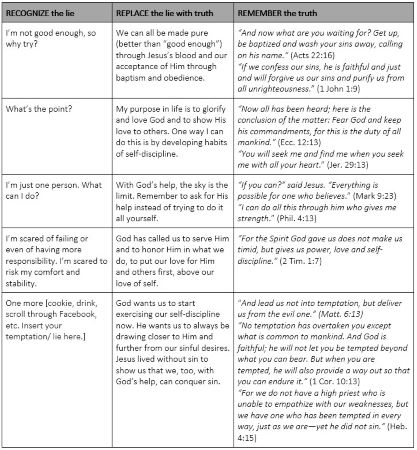
Let us ask God to help us turn good tasks into habits-- into a strong self-discipline muscle that we use every day to honor him at home, at work, and most importantly, in the Kingdom of God.
-
Unequally Yoked
 Written by Francia Oviedo, Creative Assistant for Iron Rose Sister Ministries in Honduras
I remember sitting in a park with all my friends. It was common to sit there to chat, laugh and although it seemed innocent, sometimes laugh at others. We used to have conversations that were not very useful or profitable. But one day something different happened; I realized that, unlike my friends, I was already a Christian, I had given my life to God, and I was unequally yoked.
But what is a yoke? Imagine a piece of wood with an arch carved out on each end. The head of an animal--generally an ox—is fitted in each arch, and when they are prodded by the tiller of the plow, they will pull the yoke to plow the field and create furrows in which seed will be planted. These furrows must be consistent in depth and spacing because if they are not, the seed will not be able to grow properly. This is why it is important that the two animals that are yoked together are of equal size and strength because if not, the crop will not grow properly and, above all, the animals could hurt each other if one of them pulls the yoke with more force than the other. In the Old Testament we find this verse, “You shall not plow with an ox and a donkey together” (Deut. 22:10 NASB).

So, then what do we call an unequally yoked relationship? A marriage relationship where one of the parties is not a Christian is commonly called an unequally yoked union, but I believe it goes much further than that. I think it is an issue that we must constantly pay attention to. Being unequally yoked can also apply when our lives are being influenced by worldly beliefs, cultures, ideas, ideologies, etc. where the will and holiness of God does not reign. Many times, we let these things guide our way of thinking and behaving and we end up unequally yoked, forgetting God's will for us.
Going back to my story, after giving my life to God and deciding to change my way of living and my way of speaking and expressing myself, I continued walking around with my friends who continued doing the same things that I no longer wanted to do. That day in the park while everyone was having a conversation and laughing at a boy who was passing by, saying things that had no purpose for me, I understood that that was no longer where I needed to be, and I decided to leave this environment and these companions. As 1 Corinthians 15:33 says, “But don’t be so naïve—there’s another saying you know well—Bad company corrupts good habits" (The Voice). I really liked enjoying time with my friends, but it was no longer a place for me.
With this, I am not saying that we have to abandon friends, a partner, a job, or a project, but it is about understanding and respecting our purpose of keeping ourselves in the will of God. I believe that when we demonstrate this firmness, which of course we must do with a lot of love and respect for others who do not believe in God, we can show the light of Jesus and we can become references for them when they need God.
As for my friends, I can say that, although I distanced myself a little from them and that unhealthy environment, I continued to be in regular contact with them, since I also know that my purpose is to share the message of God, trying to be a light for them, while always guarding my heart.
And well, I already told you what I had to give up, and I assure you that there are things that I must be constantly evaluating in my life: what conversations do I have, what music do I listen to, what videos or series do I watch? I must constantly check my heart and analyze what I am unequally yoking myself to.
And you, what relationships, conversations, movies, books, ___________ (fill in the blank with your challenge) are you unequally yoking yourself to? I encourage you to put those things in God’s hands in prayer. May He always help you guard your heart and not be unequally yoked.
-
We Are a Whole
 Written by Liliana Henriquez, volunteer for Iron Rose Sister Ministries in Colombia
I don't know what has happened lately, but I have felt that the world has accelerated, and we are living life at high speed like "X2" in WhatsApp audios. On the one hand, it has been wonderful because we have managed to do many things in less time. Technology has helped us a lot and has made knowledge available to everyone. So there are no more excuses to grow and improve in any area of our lives. But, on the other hand, we live so fast-paced that sometimes, we forget to enjoy the moment and be grateful for the blessings that God is giving us day by day.
Today I want to focus on the positive side of this acceleration, and one of the things I love about this era is globalization. Geographical barriers are no longer obstacles to communicating and connecting with one another anywhere in the world. We already see our individual selves as a whole. We have normalized different time zones and cultures. We have friends and clients all over the world, and we feel they are super close thanks to video calls or Zoom meetings.
Another positive aspect of globalization is everyone's access to the Gospel. People are recognizing the need for Christ. We have seen it in the lives of artists and famous people who have publicly shared their faith journeys and inspired others to make the decision to accept Christ and obey the Gospel. That makes me very happy!
I feel that more and more people are using their platforms or channels of influence to impact the world positively, making Christ better known and giving relevance to the spiritual area. We are exercising our freedom in the right way.
Though I am free and belong to no one, I have made myself a slave to everyone, to win as many as possible. To the Jews I became like a Jew, to win the Jews. To those under the law I became like one under the law (though I myself am not under the law), so as to win those under the law. To those not having the law I became like one not having the law (though I am not free from God’s law but am under Christ’s law), so as to win those not having the law. To the weak I became weak, to win the weak. I have become all things to all people so that by all possible means I might save some. I do all this for the sake of the gospel, that I may share in its blessings. (1Co 9:19-23 NIV)
Christ is not religion. He is a relationship and a lifestyle. It should be noted that we are disciples of Christ not only in the church but in our work, friendships, relationships, etc. It doesn't make sense to be a Christian in select specific areas or places. We are a WHOLE; soul, mind, and body, and we must be coherent and congruent with what we profess. If we are Christians, we must act as Christians in our daily lives. In this way, we can put into practice one of my favorite phrases: "Preach the Gospel at all times, and if necessary, use words" (St. Francis of Assisi).
We were called to make Christ known at every moment. This is the good news that this fast-paced world needs!
-
We Are Spiritual Athletes
 Written byKathy Reagan,volunteer with Iron Rose Sister Ministries in Texas.
Think about someone you consider ‘an athlete.’ What comes to mind first? How hard they exercise and train and how dedicated they are, right? Rain or shine, they are carrying on with their training. Nothing stops them.
Are we just as dedicated to our spiritual training (Heb 5:14)?
I began my karate training at age 29. It helped me on many levels: physically (strength, flexibility, balance, and agility to name a few) and mentally (to stay focused and humble). It took three years of daily classes and practice outside of class to achieve my first black belt rank. After that, I was blessed to open my own dojo (karate school) which I had for over 20 years. I had many students throughout the years who trained hard, not only in my classes but also daily at home. These students were a constant delight!
There are many parallels between physical and spiritual training! For both:
- We need the will to succeed – it takes deliberate effort.1 Corinthians 9:24 (ESV) says, “Do you not know that in a race, all the runners run, but only one receives the prize? So run that you may obtain it.” God’s will is for each of us to “...grow in the grace and knowledge of our Lord and Savior Jesus Christ” (2Pe 3:18). Growth in any area isn’t easy, whether it’s physical, mental, or spiritual. But we choose to work hard, in the study of His Word, to see improvements in ourselves.
- We need daily self-discipline – Let’s read on in 1 Corinthians 9:25, “Every athlete exercises self-control in all things. They do it to receive a perishable wreath, but we an imperishable one.” Athletes train hard every single day, not just occasionally or when they feel like it, but consistently.
- In what we internalize – spiritual food. Psalm 119:11, “I have stored up Your Word in my heart, that I might not sin against You,” and Colossians 3:16, “Let the Word of Christ dwell in you richly,” emphasize the importance of Christ living in us. We know that when we allow the world in through our eyes and ears (ungodly TV, videos, reading material, music), it’s like an athlete bingeing on junk food and expecting to do well in competition. It just won’t happen.
- In what we do – “But as He who called you is holy, you also be holy in all your conduct” (1Pe 1:15). In James 1:27, we see that God’s will is for us to “…keep oneself unstained from the world.”
- In how we think - “Set your minds on things that are above, not on things that are on earth”(Col 3:2).In 2 Corinthians 10:5, we’re instructed to “Take every thought captive to obey Christ.”
Is self-control always easy? No, it is rarely easy. That’s why we rely on our Father, laying each struggle at His feet, bringing each challenge to Him in prayer.
- We need daily practice – Of the karate students I taught, the ones who succeeded were those who practiced daily, in class and at home. There are many ways to practice our service to God! What gifts has God given you? Do you have a heart for the poor? Are you able to teach? Are you a natural encourager? Do you love to show hospitality? Just like an athlete practices every day to get better, we also get better at serving God as we step out in faith and serve others. James 1:27 tells us “Religion that is pure and undefiled before God the Father is this: to visit orphans and widows in their affliction…”.
I had a few students, over the years, who achieved their black belts and then went on to open their own karate schools. They were fully trained. “A student is not above his master”, but when fully trained, will be like his master. Matthew 10:24-25
Spiritual training is so much more important in this life than physical training!
With physical training, you might get in great shape and be lightning fast, strong and agile, but that only has small value for a Christian. Rather “…train yourself for godliness, for while bodily training is of some value, godliness is of value in every way, as it holds promise for the present life and also for the life to come” (1Ti 4:7-8).
Sisters, let’s make the deliberate effort to grow in the grace and knowledge of God’s Word – study! Ask for God’s help daily to exercise self-control in all things – pray! And intentionally choose ways to imitate Jesus every single day by ministering to others – practice!
As spiritual athletes, I pray that we are a constant delight to our Father in heaven, obedient students who train hard in everyday life to be like our Master.
-
Well Done, Good and Faithful Servant
 Written byJocelynn Goff, Volunteer with Iron Rose Sister Ministries in Arkansas
“Well done, good and faithful servant!” (Mt 25:21a). As Christians, these are words of blessing and affirmation we all long to hear. They bring hope and peace to our souls as we live out our faith in a world full of struggles, hurts, and deception. This begs the question: How can we make sure we hear these words?
To answer that question, let’s look at the whole context of the story that Jesus tells us.
Again, it will be like a man going on a journey who called his servants and entrusted his property to them. To one he gave five talents of money, to another two talents, and to another one talent, each according to his ability. Then he went on His journey. The man who had received the five talents went at once and put his money to work and gained five more. So also, the one with the two talents gained two more. But the man who had received the one talent went off, dug a hole in the ground and hid his master’s money. After a long time the master of those servants returned and settled accounts with them. The man who had received the five talents brought the other five. ‘Master, he said, you entrusted me with five talents. See, I have gained five more.’ His master replied, ‘Well done, good and faithful servant! You have been faithful with a few things; I will put you in charge of many things. Come and share your master’s happiness!(Mt 25:14-21)
If we were to read further, we’d see that the man given two talents received the same affirming words, “Well done, good and faithful servant” (Mt 25:23a). However, the man who was given one talent did not receive these same words of blessing. Instead, he received harsh words from his master. “You wicked, lazy servant!” (Mt 25:26a).
Wait, couldn’t the one-talent man have also received the words, “Well done, good and faithful servant”? Yes, I believe he could have. However, he acted out of fear and assumed his master was a hard man, so he went and hid his talent in the ground.
In contrast, I’m confident that my parents, who have both recently ascended to their eternal reward, have heard those precious words, “Well done, good and faithful servant.” They were definitely faithful stewards of the five talents that their Master had given them to bless others and give glory to Him. In turn, they were given other things with which to be in charge. While I realize that the reference in scripture refers to money, I believe it has application for abilities also. My parents used both money and abilities to multiply their Master’s Kingdom.
I’ve also known many faithful stewards who were given one talent but are not acting in fear, nor are they comparing themselves with those who have been given more talents. Rather, by faith, they are in the Kingdom business of using their money and abilities to the glory of God.
The question to each of us is not what number of talents we have been given by our Master but rather are we faithful stewards of those talents? Are we using them or hiding them? I pray that each of us will assess ourselves, be about Kingdom business with what we’ve each been given, and will all hear the blessed words, “Well done, good and faithful servant”.

See more photos on our Photo Gallery page.
(c) Iron Rose Sister Ministries. Site setup by Perfect Fit Web Design; Flag icons by Free Flag Icons